FAST THR33
FAST THR33 is a reduced version of FAST5 Netball, intended for the community or grassroots setting, and developed for teaching game concepts in situations where there are limited resources.
The rules governing the FAST THR33 concept of netball are based on the INF Rules of Netball and the INF Rules of FAST5 Netball. Any rule not specifically modified for FAST THR33 herein shall remain as prescribed by the International Netball Federation.
Playing Area
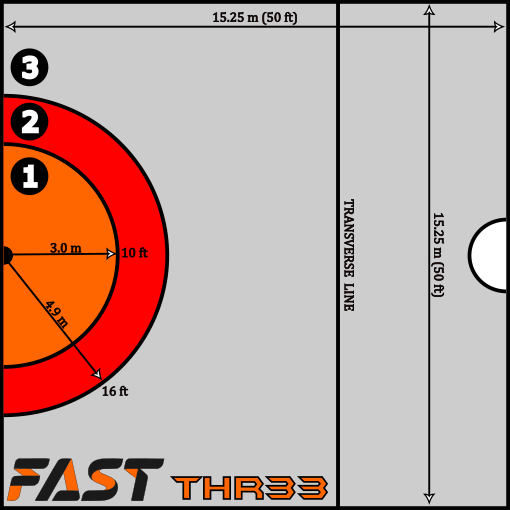
The game will be played in one half of a standard FAST5 netball court, or a playing area of like dimensions with similar design. The playing area shall have one goal, with an inner and outer goal circle.
Teams
To register for a match a team will require 5 players (3 players on the playing area and 2 substitutes). The total number of players and gender composition of teams will be determined by the organizer.
There are five playing positions in each team whose playing areas are the same as in FAST5 Netball:
Goal Shooter (GS), Goal Attack (GA), Centre (C), Goal Defense (GD), and Goal Keeper (GK).
The positions GS and GK shall be coupled as GS-K, and played by one player.
The positions GA and GD shall be coupled as GA-D, also played by one player.
Beginning of the Game
A coin flip shall determine which team gets the first possession. The team that wins the coin flip can either choose to benefit from the ball possession at the beginning of the game, or at the beginning of a potential overtime (playoffs).
The game cannot begin if one of the teams is not on the playing area with at least two players (one must be a Center) ready to play.
The game starts when the ball is at the disposal of a player on offense, behind the transverse line at the top of the goal third. The ball shall be at the disposal of the team on offense when assigned by the umpire or by a check-ball procedure with the defensive team.
Scoring
A goal is scored when the ball is thrown or batted over and completely through the ring by the Goal Shooter or Goal Attack from any point within the goal third.
Each successful goal scores a number of goal points as specified below. The number of points is determined by the place from which the shot is taken.
- 3 goal points (super shot) – the player is not in contact with the ground in the goal circle while shooting.
- 2 goal points – the player had contact with the ground in the outer circle but was not in contact with the ground in the inner circle while shooting.
- 1 goal point – the player had contact with the ground in the inner circle while shooting.
If, while shooting, a player is in contact across two circle areas, the shot is deemed to have been made from the area that scores the fewer number of goal points.
Where a defensive team establishes ball control and scores a goal without clearing the ball, the goal shall be invalid as the team had not cleared the ball prior to the shot attempt. This shall include controlled taps and put-back shots.
Playing time/ Winner of the Game
Regular playing time shall be 1 period of 10 minutes running time.
Note: the organizer may decide on a longer playing time for the finals.
The first team to score 9 points or more during regular playing time wins the game. This “sudden death” rule applies to regular playing time only (not during overtime).
Note: if a longer playing time is decided for the finals, the sudden death score shall be increased by one point for each additional minute, but shall not exceed 13 points for a period of 15 minutes.
If the score is tied at the end of regular playing time, and a winning team is required (playoffs), an overtime shall be played. There shall be an interval of 1 minute before the overtime starts. The first team to score 3 points or more in the overtime wins the game.
Starting the Game/ Offense
The game starts when the ball is at the disposal of the player on offense behind the transverse line at the top of the goal third.
Note 1: The ball shall be at the disposal of the offense, behind the transverse line, after:
- assignment of ball possession by the umpire; or
- a check-ball procedure has been completed with the defense.
Note 2: The pass from behind the transverse line is NOT a Centre pass, and may be made by the Centre or Goal Attack.
Note 3: The pass from behind the transverse line may be received by a player on offense anywhere on the playing area.
Check-ball Procedure
This procedure shall be used when approved by the umpire during match play, or for games played without an umpire.
Method:
- One player on offense shall stand with the ball behind the transverse line at the top of the goal third. This player shall then pass or hand the ball over to a player on defense stating, “CHECK”.
- On receipt of the checked ball the player on defense shall notify the rest of the team of the start of the offense by announcing,”BALL IN PLAY” or simply, “PLAY”.
- The defense shall then pass or hand the ball back to the player on offense behind the transverse line.
- The ball shall be at the disposal of the offense on receipt of the checked ball from the defense.
How the Ball is Played / Clearing the ball
Following each successful goal a player from the non-scoring team shall resume the game after assignment of ball possession by the umpire, or a check-ball procedure with the defense, behind the transverse line at the top of the goal third. When the ball is at the disposal of the offense the player may pass the ball to begin the offense.
Following each unsuccessful attempt at goal, if the offensive team rebounds the ball, it may continue to attempt to score without clearing the ball. If the defensive team rebounds the ball, it must clear the ball before attempting to score.
To clear the ball the team must pass the ball until it is received by a player on the team who is established behind the transverse line.
Note: To be considered as being established behind the transverse line, one foot must be in contact with the floor behind the transverse line, and no body parts should be touching the floor inside the goal third, whilst in possession of the ball.
If the defensive team steals or blocks the ball inside the goal third, it must clear the ball before attempting to score.
Possession of the ball given to the offensive team following a violation of rules by the defense will be handled in accordance with the INF Rules of Netball.
Possession of the ball given to the defensive team following a violation of the rules by the offense, must be cleared behind the transverse line before attempting to score.
Player Zones
Players may use the entire playing area to move the ball, except:
- the Centre may not enter the goal circle; and
- The Goal Shoot may not cross the transverse line.
Assignment of Ball Possession Behind the Transverse Line
A team may be assigned ball possession behind the transverse line in the following cases:
- At the start of regular time;
- At the start of an overtime;
- After a time-out interval;
- After a made goal.
Substitutions/Exchanging Positions
Substitutions shall be completed in accordance with Rule F8 of the INF Rules of FAST5 Netball.
Multiple substitutions may occur during the game without the assistance of umpires. The substitution, however, must occur outside the playing area.
Teammates may exchange positions at any time, however, an offside violation will be called if a player is found in an area not assigned to the current position.
Time-outs
Each team may be allowed one 45-second time-out up to the start of the last 3 minutes of play. No time-outs in the final 2 minutes.
Game Management
The objective of the Game is for the attacking team to progress play to the goal end in order to attempt to score a goal. Play that does not meet this objective (e.g. passing the ball simply to use up time) is considered to be ‘not in the spirit of the Game’.
In such a case:
- The umpire calls ‘USE IT’ and points to the goal as a signal that the team must immediately progress the ball towards the goal end in order to attempt to score a goal;
- If the team fails to immediately carry out the umpire’s instruction the team is penalised;
- Sanction: Penalty pass awarded just outside the goal circle to the non-infringing team and the offending team is cautioned.
- This signal remains in effect while the team has possession or until a shot at goal has been attempted.